
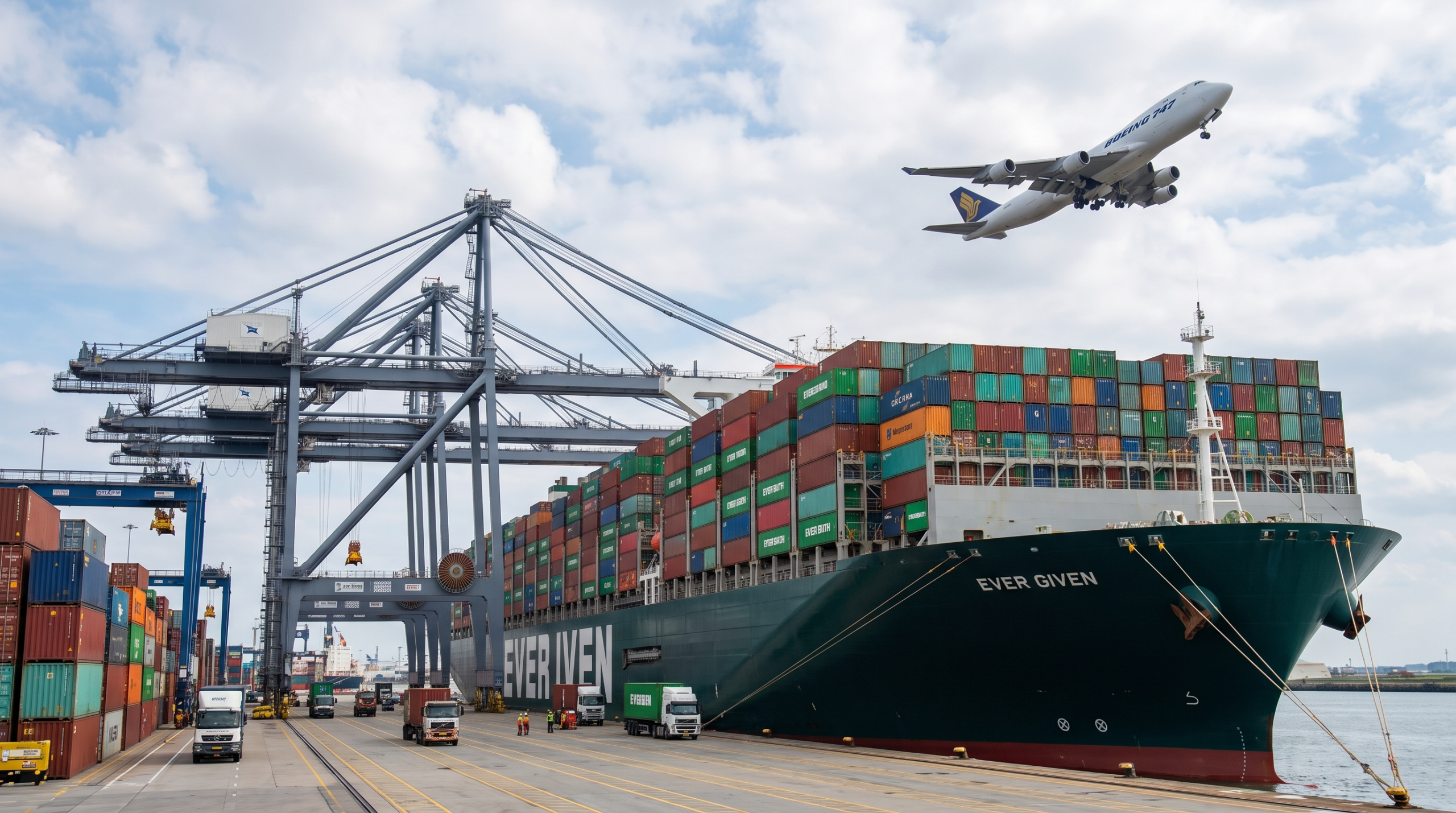
Every growing store eventually hits the same wall. Your supplier is ready, your cash is committed, and now someone has to decide how the inventory actually crosses the ocean. Get it right and you protect a quarter of margin. Get it wrong and you either pay four times too much for freight or you go out of stock during your best selling weeks.
Tea ocean freight vs air freight decision is usually framed as cheap-and-slow against fast-and-expensive. That framing is incomplete, and it is why so many sellers default to whichever mode they used last time. The real answer depends on unit economics, sell-through velocity, cash cycle and how much your stockout actually costs.
This guide gives you the 2026 numbers, the break-even math and a decision framework you can apply to your next purchase order.
What each mode costs in 2026
Freight pricing moves constantly, so treat these as planning ranges rather than quotes. Rates vary by lane, season, career contract and how much space is available the week you book.
| Fashion | Typical 2026 rate | Port-to-port transit | Door-to-door realistic | Best for |
|---|---|---|---|---|
| Air freight (standard) | $3.50-$7.50 per kg | 3-7 days | 7-12 days | Launches, urgent restocks, high-value/low-weight |
| Air Express (courier) | $6-$12+ per kg | 2-4 days | 3-6 days | Samples, emergency top-ups, tiny volumes |
| Ocean LCL (shared container) | $40-$110 per CBM | 14-25 days | 30-45 days | Mid-size restocks, 1-10 CBM |
| Ocean FCL (full container) | Roughly $0.15-$0.45 per kg equivalent | 14-20 days | 30-40 days | Full 20ft/40ft loads, predictable sellers |
The headline gap is stark. We have 1,000 kg shipment from Asia to the US West Coast, air lands somewhere around $3,800-$5,800 while ocean LCL comes in near $450-$900. That is a four-to-fifteen-times premium for arriving three weeks earlier.
The door-to-door trap
Notice the difference between port-to-port and door-to-door in the table above. Ocean's 14-day sailing becomes a 30-to-45-day planning cycle once you add origin cartage, consolidation, customs clearance, deconsolidation and inland delivery to your warehouse. LCL is worse than FCL here because your cargo waits for the container to fill on both ends.
Sellers who plan against sailing time rather than door-to-door time are the ones who run out of stock. Build your reorder point on the number in the fourth column, not the third.
The break-even math
The dividing line is not a weight, it is a ratio. Air is priced on chargeable weight — the greater of actual weight or volumetric weight — while ocean LCL is priced on cubic meters. So the question is really: how dense is your product?
As a working rule for 2026:
- Under roughly 150-200 kg of dense cargo, or under about 1 CBM, air usually wins on total cost once you include the fixed fees ocean freight carries regardless of size.
- Between 200 kg and 1 CBM (approximately), it is genuinely closed, and velocity should decide.
- Above 1-2 CBM, ocean's per-unit advantage becomes hard to argue with unless the inventory is time-critical.
Ocean shipments carry minimum charges, documentation fees, terminal handling, chassis and destination charges that do not scale down. A 0.5 CBM LCL shipment can end up costing more than air once every line item is added, which surprises first-time importers constantly.
Calculate cost per unit, not cost per shipment
The only number that matters is freight cost per sellable unit. A $4,500 air shipment carrying 3,000 units costs $1.50 per unit. A $700 ocean shipment carrying 600 units costs $1.17 per unit. Suddenly the four-times-cheaper option is barely cheaper at all.
Run this calculation on every purchase order before you assume ocean is the frugal choice. High-value items with strong margins often absorb air freight comfortably; low-margin commodity goods almost never do.
The costs that do not appear on the freight invoice
Comparing freight quotes alone is how sellers make expensive mistakes. Four hidden costs regularly flip the decision.
- Capital tied up in transit. Forty days of inventory on the water is forty days your cash is unavailable. For a fast-turning store, that working capital cost can exceed the freight savings entirely.
- Stockout and ranking damage. Going out of stock does not just cost the lost sales. On marketplaces it costs organic ranking, and recovering a listing's position after a stockout can take weeks of paid traffic.
- Safety stock requirements. A 40-day lead time forces you to hold far more buffer inventory than a 10-day lead time. That buffer has a storage cost, and at Amazon it can trigger long-term storage fees.
- Duty and customs exposure. With low-value exemptions gone on US inbound parcels, formal entry, brokerage and duty apply either way — but a larger consolidated shipment amortizes clearance costs across more units than a series of small air shipments.
The honest version of the comparison is: freight cost, plus storage cost, plus capital cost, minus the revenue you protect by arriving sooner.
A hybrid strategy beats picking one mode
Experienced sellers rarely choose one mode for a whole SKU. They split the purchase order.
- Air the opening tranche. Send 15-25% of the order by air so you have sellable stock in 10 days, and put the balance on the water. You get launch velocity and bulk economics from a single PO.
- Air your top movers, sail the long tail. Your fastest-selling variants justify the premium; the slow colors and sizes do not.
- Use air as your storage insurance. Keep an air lane pre-negotiated so an emergency restock is a booking, not a scramble at spot rates.
- Book ocean ahead of peak. Capacity tightens and rates climb in the run-up to the holiday season. Ocean bookings made in the last minute lose most of their cost advantage.
- Consolidate suppliers into one container. If you buy from several factories in the same region, a consolidator can combine them into one FCL and beat LCL pricing outright.
Choosing your mode: a quick decision path
Work through these in order for each purchase order.
- Is it under 1 CBM? Price air first. Ocean's fixed costs will probably erase the savings.
- Do you have more than 45 days of coverage? If yes, ocean is the default. If no, you are already in air territory whether you like it or not.
- What is your gross margin per unit? Above roughly 60%, air freight rarely breaks the model. Below 30%, ocean is closed to mandatory.
- Is this a launch or a proven SKU? Launches and unvalidated products belong on air in small quantities. Proven, forecastable sellers belong on the water.
- Is peak season within your transit window? If your ocean arrival lands after your selling window opens, the cheap option just became the expensive one.
The bottom line
Ocean freight is three to five times cheaper per kilogram, and for large, dense, predictable restocks that advantage is decisive. But for small shipments, launches, high-margin products and anything where a stockout would cost you ranking, air freight regularly wins on total landed economics even at four times the freight rate.
Stop treating this as a fixed policy. Price both modes on every purchase order, convert the result to cost per unit, and add the working capital and stockout costs before you decide. All rates in this guide are indicative and vary by lane, season, volume and carrier agreement — always confirm against a live quote.
Need help getting your inventory from the port to your customers without bleeding margin on the last mile? HereWeShip gives ecommerce sellers discounted multi-carrier rates, landed cost visibility and fulfillment support built for cross-border growth. Talk to our team today and get your shipping costs under control.