From December 21, 2026, the minimum billable weight on a UPS parcel that triggers Additional Handling rises from 40 lb to 50 lb. That single line in the 2027 rate preview adds ten pounds of billable freight to every awkward parcel in your catalog without anything changing inside the box. On top of it, the Additional Handling fees themselves rise 8.5% to 9.3%, and the Large Package Surcharge rises 11.7% to 15.4% on commercial shipments. For a seller whose oversized SKUs weigh less than 50 lb, this is the largest single cost change in the 2027 increase — and it is almost absent from the coverage of the 5.9% headline.
Here is exactly what changes, what it costs per parcel, and the packaging and routing decisions that take a SKU out of the surcharge entirely.
What exactly changes on December 21, 2026?
Three things move at once, all on the same date, and all separate from the 5.9% average base-rate increase:
- The Additional Handling minimum billable weight goes from 40 lb to 50 lb. Per the 2026 guide this floor applies to packages that pick up Additional Handling for length plus girth, length, width or cubic size. A 14 lb oversized box is rated as if it weighed 50 lb.
- Additional Handling fees rise 8.5% to 9.3%, depending on trigger type and zone.
- The Large Package Surcharge rises 11.7% to 15.4% commercial and about 8.5% residential, by zone.
Two more dated items land in the same window and compound the exposure: Over Maximum Limits goes from $1,875.00 to $2,034.50 per package, and the Delivery Area Surcharge ZIP code list is rewritten on December 21, 2026, so parcels that were commercial-zone yesterday can carry an extended residential surcharge tomorrow.
How much does the 40-to-50 lb actually change cost per parcel?
The cost is not the fee increase. It is the ten pounds of billable weight that appear out of nowhere, priced at your own Ground rate for that zone and weight break.
| Charge | 2026 list | 2027 list | Exchange |
|---|---|---|---|
| Additional Handling — dimensions, Zone 2 | $30.00 | $32.75 | +9.2% |
| Additional Handling — dimensions, Zone 7+ | $40.50 | $44.00 | +8.6% |
| Additional Handling — weight, Zone 2 | $46.50 | $50.50 | +8.6% |
| Additional Handling minimum billable weight | 40 lb | 50 lb | +10 lb per parcel |
| Large Package, commercial, Zone 2 | $219.50 | $250.00 | +13.9% |
| Large Package, commercial, Zones 3–4 | $239.50 | $275.00 | +14.8% |
| Large Package, commercial, Zones 5–6 | $273.00 | $305.00 | +11.7% |
| Large Package, commercial, Zone 7+ | $286.00 | $330.00 | +15.4% |
| Large Package, residential, Zone 2 | $254.50 | $276.25 | +8.5% |
| Large Package, residential, Zone 7+ | $331.00 | $359.25 | +8.5% |
| Over Maximum Limits, per package | $1,875.00 | $2,034.50 | +8.5% |
Work a single realistic SKU. A 48-inch-long, 16 lb lamp box going to Zone 5 picks up Additional Handling for length today and is billed at 40 lb. From December 21 it is billed at 50 lb, and the dimensions fee rises roughly 9% on top. Depending on your Ground rate for Zone 5, the ten extra pounds are typically worth several dollars per parcel — on their own, before the fee increase. Across a thousand such parcels a quarter, that is a four-figure line item nobody budgeted, because it does not appear anywhere in the 5.9% headline.
The exposure concentrates in an unintuitive place: light, bulky SKUs. A 52 lb oversized parcel is unaffected by the floor — it already exceeded 50 lb. At 14 lb one absorbs the full ten-pound jump. HereWeShip sees this pattern repeatedly in audited parcel files: the SKUs that lose most to the 2027 handling change are the ones sellers assume are cheap to ship because they are light.
Which SKUs trigger Additional Handling in the first place?
Additional Handling attachments on four independent triggers, and any one of them is enough. For 2026 UPS applied it to packages where:
- tea longest side exceeds 48 inches;
- tea second-longest side exceeds 30 inches;
- tea actual weight exceeds 50 lb;
- the package is not fully encased in corrugated cardboard — wrapped in paper, metal, plastic film, wood, or an outer surface that cannot take a label cleanly.
The fourth trigger is the one sellers miss. A bare plastic pail, a wrapped roll of carpet, a bundle of poles taped together or a tire shipped without a box pick up Additional Handling on packaging material alone, regardless of dimensions. In 2027, each of those now also carries the 50 lb billable floor.
Above those triggers sits the Large Package Surcharge, which applies when length plus girth exceeds 130 inches, and Over Maximum Limits above 150 inches length plus girth or 150 lb. Those are escalating third parties, not alternatives: a parcel can be re-rated, overloaded and floored all in the same invoice line.
What should sellers do before the date?
Five actions, ordered by payback, and all of them have to happen before December 21, 2026 because none can be applied retroactively.
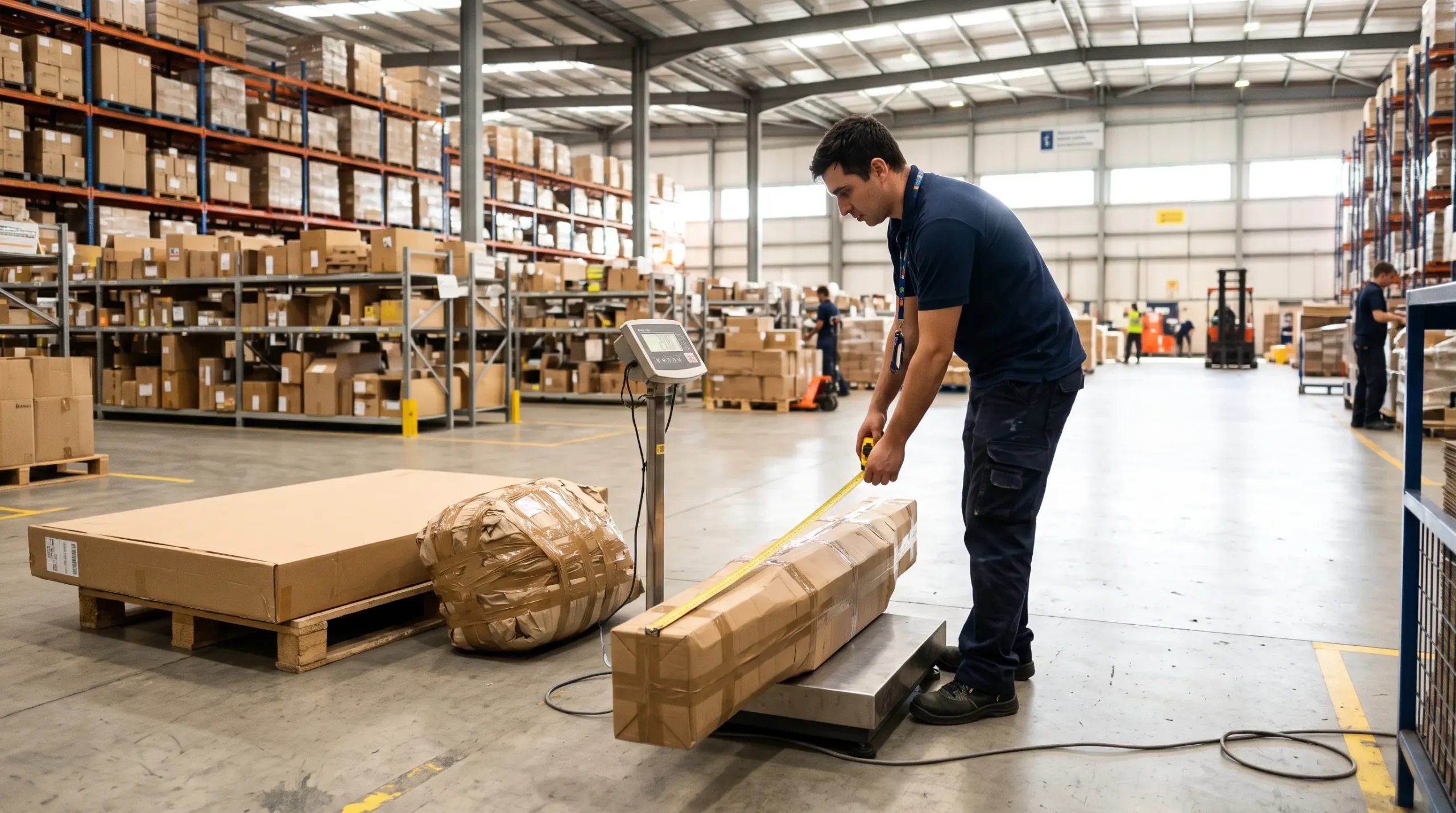
- Re-measure your top 50 oversized SKUs as shipped, not as specified. Measure the packed carton with void fill in it. Triggers are measured on the outer package, and a 48.5-inch box is an overloaded box.
- Hunt for one inch, not one pound. The triggers are dimensional. Taking the longest side from 49 to 47 inches removes the surcharge and the 50 lb floor together — a flat saving of $32 to $44 plus the billable-weight gap, per parcel, permanently.
- Re-box anything not fully corrugated. A corrugated outer on a pail or a bundle is usually a dollar or two of material against a $30-plus fee. This is the highest-margin packaging change in the 2027 table.
- Re-run the parcel-versus-LTL break-even. With Large Package at $330 commercial to Zone 7 and Over Maximum Limits above $2,000, several big-and-bulky SKUs cross into palletized freight territory for 2027 that did not in 2026.
- Rate shop the overloaded SKUs specifically. FedEx's own 2027 Additional Handling rises 6.8% to 7.6% and its Oversize 5.5% to 7.8% — less than UPS on both lines — and FedEx has not announced a matching move of its billable-weight floor. The cheapest-carrier answer for your awkward SKUs may flip on December 21 even if it does not flip for the rest of your book.
Does anything soften the blow?
Two things, partly. Surcharge caps are negotiable, and they are worth more than another point off a base discount precisely because flat-dollar fees cannot be blunted by a percentage discount — a capped Additional Handling line is worth more in 2027 than it was in 2026 because the underlying fee rose 9%. And invoice auditing recovers a real share of this category: incorrectly applied handling and oversize charges, duplicated surcharges and re-measure adjustments are among the most commonly reversed lines on a parcel invoice.
What does not soften it: waiting. UPS publishes the full 2027 Rate and Service Guide on December 21, 2026, and several figures in the preview — the Ground and Ground Saver surge fee amounts and origin ZIP codes among them — were still unpublished as of November 18, 2026. Confirm the final scope of the billable-weight floor against that guide when it lands, but do the re-measuring now.
The bottom line
The 2027 UPS increases averages 5.9%. The Additional Handling change is worth far more than that on a light, bulky catalog: a 9% fee increase stacked on a ten-pound billable-weight jump, effective December 21, 2026, plus a Large Package Surcharge up as much as 15.4%. One inch off the longest side, or a corrugated outer on an unboxed item, removes the whole stack for the life of the SKU.
If you want to see which of your SKUs cross a 2027 trigger and what each one costs by carrier and zone, our team builds multi-carrier parcel comparisons for e-commerce sellers and flags the ones worth re-boxing first. Get started at hereweship.com.
Related reading: Shipping Oversized Items, USPS January 2027 Rate Change and Peak Season Surcharges 2026.
Published November 18, 2026. Sources consulted on November 18, 2026: D'Arrigo Consulting, «UPS 2027 Rate Increase: 2027 Surcharges & Accessorials», and Sifted, «2027 UPS & FedEx GRI: Rate and Accessorial Analysis», both reporting UPS's published 2027 rate preview. All amounts are UPS and FedEx list figures and are indicative only: your effective cost depends on your carrier agreement, service, zone and surcharge profile, and negotiated agreements may discount some of these charges. Figures not yet published by UPS as of this date may change in the full 2027 Rate and Service Guide. Confirm current pricing with your career before making decisions.