
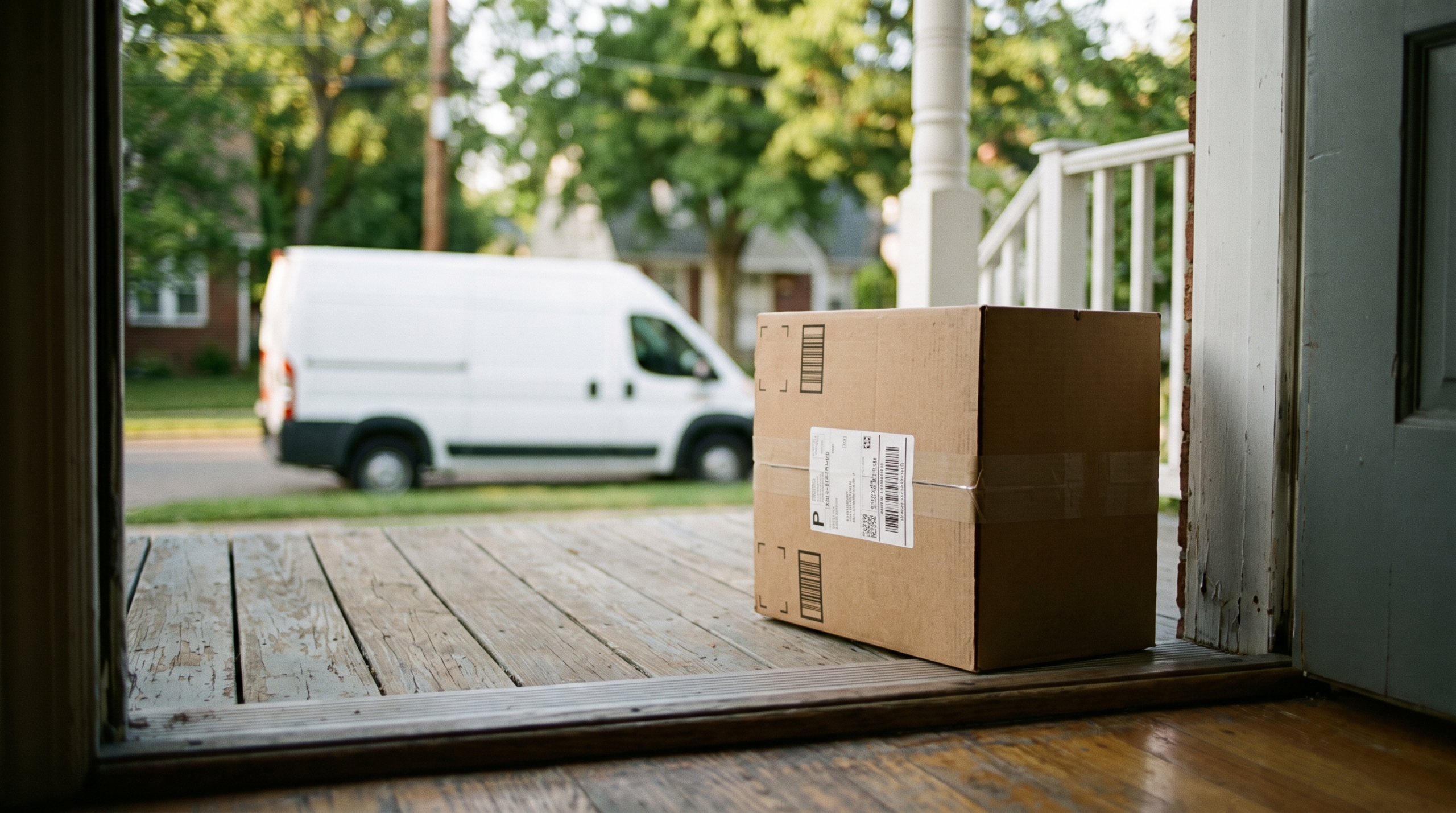
Cross-border sellers have lived with a useful asymmetry for years: domestic parcels to a house carry a residential surcharge, international parcels generally do not. That asymmetry is closing. From January 18, 2027, FedEx applies a residential delivery charge to qualifying international shipments going to select destination countries.
For a direct-to-consumer brand, almost every international order is a residential delivery. A fee that was previously a domestic-only line item becomes a fee on the majority of your export volume — and it lands three weeks after the January rate increase, when your margin model is already absorbing 5.9%.
Here is what changes, what it plausibly costs, and the three levers that actually move the number. All figures come from published career announcements and are indicative; your rates depend on your agreement, service, and destination.
What the international residential delivery charge is
A residential delivery charge is not a service. It is a network cost recovery: a house has no loading dock, no consistent receiving hours, and one parcel per stop instead of forty. Carriers have priced that into domestic grids for two decades. Extending it across borders simply applies the same logic to the same physical reality.
Three things about the 2027 change matter operationally:
- It is destination-specific. It applies to select destination countries, not all of them. Your exposure depends entirely on where your orders go.
- It is shipment-qualifying. Not every international shipment triggers it — the classification of the delivery address does.
- It arrives separately from the GRI. January 4 raises list rates. January 18 adds this charge and the new paper-document fees. Budgeting only for the first date understates the second.
The wider January 2027 picture
The residential change does not travel alone. For an international e-commerce seller, four dated changes stack inside one month.
| Date | Exchange | Who it hits hardest |
| January 4, 2027 | List rates up 5.9% average — Priority Overnight at least 6.5%, Ground ~6.1%, Express Saver ~3.1% | Anyone selling expedited international delivery |
| January 4, 2027 | Surcharges rise faster than the headline: median line ~6.25% across roughly 158 items; domestic residential moves $6.45 → $6.90 | Overload-heavy DTC profiles |
| January 18, 2027 | Residential delivery charge extended to qualifying international shipments to select countries | Cross-border DTC — nearly every order |
| January 18, 2027 | New $25 per shipment for non-electronic trade documents; new $5 per shipment for paper air waybills | Sellers still printing commercial invoices |
| February 1, 2027 | Zone reclassification for select domestic ZIP pairs, plus updated DAS and PAS ZIP lists | Domestic legs and inbound restocking |
The $25 paper-document fee deserves a second look, because it is the one item on this list that a seller can drive to zero this quarter. If any share of your international flow still moves on printed commercial invoices, that fee is larger than the residential charge and entirely avoidable through electronic trade documents.
Modeling your exposure in twenty minutes
1. Count your international residential orders
Pull 90 days of international shipments and split them by destination country. Then split each country by address type. For most DTC brands the answer is uncomfortable: 90% or more are residential.
2. Apply the charge only where it lands
Once the qualifying-country list is published, multiply your residential volume in those countries by the per-parcel charge. Keep the other countries out of the model — over-provisioning a surcharge across your whole book leads to overpriced shipping options and abandoned carts.
3. Compare it to your contribution margin per order, not per parcel
A surcharge that is 4% of shipping cost may be 0.8% of order value on a $120 basket and 6% on a $18 basket. The same fee is trivial in one catalog and fatal in another. Decide per SKU tier, not globally.
Three levers that actually move the number
Offer a pickup point as a first-class option. A parcel delivered to a locker, PUDO point, or access point is a commercial stop, not a residential one. Where the network supports it, presenting the pickup option beside home delivery — with its own accurate date — moves a meaningful share of orders off the residential classification entirely. Shoppers in much of Europe already prefer it.
Consolidate, then inject locally. Shipping one consolidated freight movement into a destination market and injecting into a local carrier converts an international residential delivery into a domestic one under a different rate card. The break-even is usually somewhere in the low hundreds of parcels per month per country — worth modeling before you assume it is only for large sellers.
Go paperless before January 18. Electronic trade documents remove the $25 fee, cut clearance delays, and reduce the document errors that trigger customs holds. This is the highest-return change on the list and it needs no negotiation.
What to tell your customers
Do not bury a new surcharge inside a product price and hope nobody notices — shoppers compare landed cost at checkout, and an unexplained rise reads as a price increase. Two honest approaches work: raise the free-shipping threshold in affected countries, or show the delivery charge as a line in the landed-cost breakdown next to duties and VAT. Both are better than silently thinning your own margin until someone notices at quarter end.
The bottom line
The international residential delivery charge is a small number attached to a very large share of your orders, which is exactly the shape of fee that erodes cross-border margin without ever appearing as a problem. Sellers who count their residential volume by country now, move what they can to pickup points, and withdraw paper documents before January 18 will absorb it. Sellers who budget only for the 5.9% will find the rest of it in February.
Shipping internationally and want the real per-order cost? HereWeShip helps ecommerce sellers model landed cost by destination, open pickup-point delivery, and move trade documents electronic. Talk to us about your cross-border costs.