Few numbers on your store influence revenue and margin at the same time as forcefully as your free shipping threshold. Set it too low and you give away delivery costs on orders that were coming anyway. Set it too high and shoppers abandon their carts. Get it right, and the same customers spend more to unlock free delivery — while you protect your bottom line.
With carrier rates climbing again in 2026, that balance has never been more delicate. This guide breaks down where thresholds sit today, the math behind the optimal number, and how to roll one out without torching your profit.
Benchmarks below are indicative and vary by category, region, and basket size — treat them as starting points for testing, not fixed rules.
Why the free shipping threshold matters so much
Free shipping is no longer a perk — it’s an expectation. Surveys consistently show the majority of online shoppers abandon carts when they hit unexpected delivery fees, and a large share will add items specifically to qualify for free shipping. In fact, around 58% of consumers add extra items to their cart just to reach a free shipping threshold, and offering free shipping has been shown to lift average order value (AOV) by roughly 15% to 20%.
That’s the lever. A threshold isn’t a giveaway — it’s a nudge that reshapes basket size. The question is where to set the bar so the nudge pays for the shipping you’re absorbing.
2026 benchmarks: where thresholds sit now
Across ecommerce, the average free shipping threshold currently sits around $64, with most brands landing in the $60–$70 range. Roughly 45% of retailers use conditional free shipping tied to a minimum order rather than offering it on everything.
Context matters, though, because thresholds only make sense relative to what your customers already spend. Global AOV sat near $150 in late 2025, but it swings hard by region — about $183 in the Americas, $135 in APAC, and $128 in EMEA — and by device, with desktop baskets (~$192) running well ahead of mobile (~$133). A threshold that’s aggressive for a mobile-heavy apparel store could be trivially low for a desktop-driven B2B catalog.
The AOV math: how to set your number
The most reliable rule is to anchor the threshold to your own average order value, not to a competitor’s headline number. The widely used guideline: set your free shipping threshold 15% to 30% above your current AOV.
If your AOV is $65, a threshold in the $75–$85 range pushes shoppers to add one more item without feeling out of reach. Go much higher and the gap feels insurmountable, so customers either check out below it (and you eat shipping or lose the conditional sale) or abandon entirely. The sweet spot is close enough that one more product closes the gap.
Two refinements sharpen this:
- Exclude outliers. Calculate AOV on your typical orders, not your whole range — a handful of huge B2B orders will skew the average and push your threshold too high.
- Check your contribution margin. The added items shoppers buy to reach the threshold need to cover the shipping you absorb. If your margin is thin, lean toward the higher end of the 15–30% band.
Make sure the threshold actually pays for itself
A threshold only works if the incremental margin from bigger baskets exceeds the shipping cost you take on. Run the simple test: estimate how many orders will rise to meet the threshold, multiply the extra spend by your gross margin, and compare that to the delivery cost you’ll now cover on those orders. If the margin gain doesn’t beat the shipping bill, your threshold is too low — raise it or tighten which products count toward it.
This is also where controlling shipping cost upstream matters. Lower your own parcel costs — through right-sized packaging to fight dimensional weight, multi-carrier rate shopping, and clean address data to avoid correction fees — and you can offer a more attractive threshold without sacrificing margin.
Tactics that make thresholds convert
Setting the number is half the job; communicating it is the other half. The highest-performing stores make the threshold impossible to miss and easy to chase:
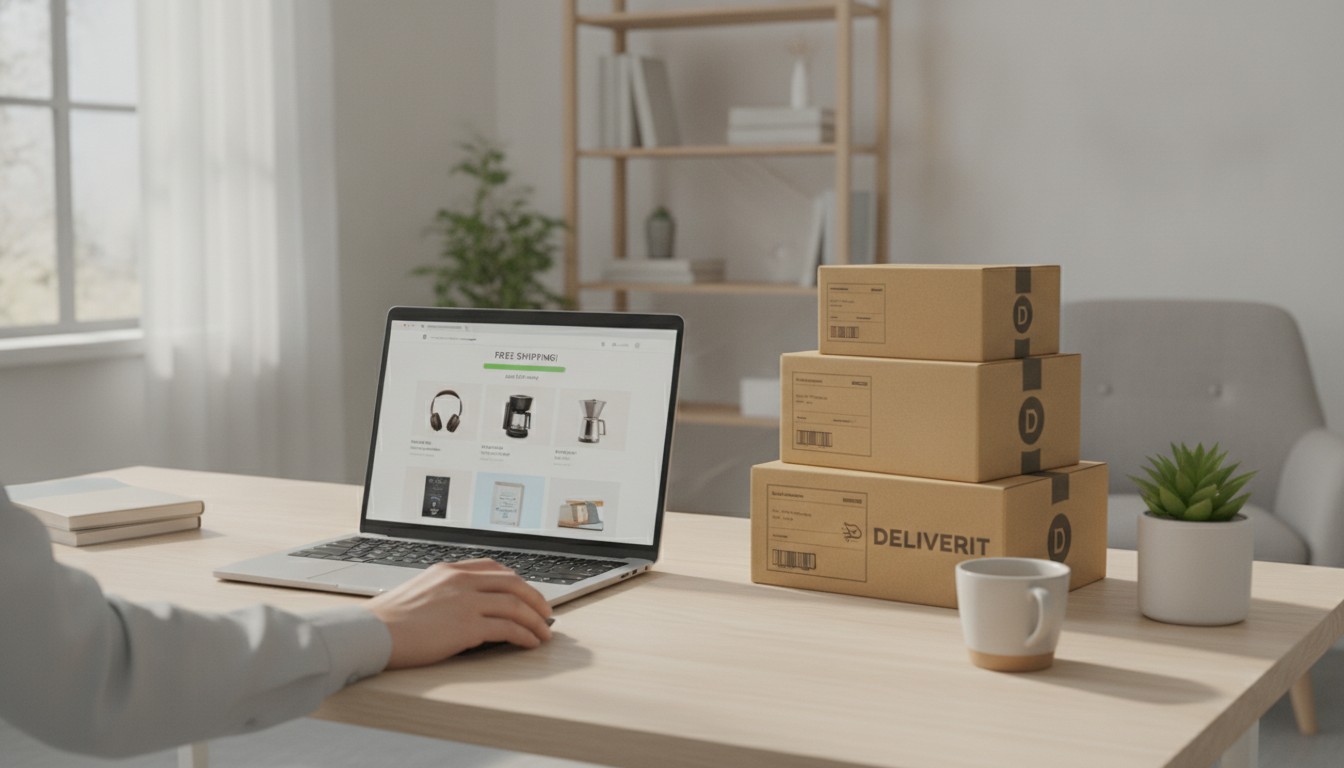
- Show a progress bar. « You’re $12 away from free shipping » is one of the most effective AOV nudges in ecommerce — it turns an abstract rule into a concrete, almost game-like goal.
- Surface it early. Put the threshold on product pages and in the cart, not just at checkout where sticker shock causes abandonment.
- Recommend the gap-fillers. Suggest low-cost add-ons priced to close the remaining distance to the threshold.
- Test seasonally. Raise the bar slightly during peak season when shipping surcharges hit, and revisit it whenever carrier rates change.
En resumen
Your free shipping threshold is one of the highest-leverage numbers in your store. Anchor it 15–30% above your real AOV, confirm the basket-size lift covers the shipping you absorb, and make the goal visible with a progress bar. Then keep testing — the right threshold in January may need adjusting once 2026 peak-season surcharges land.
Want to lower the shipping costs behind your threshold so you can offer a sharper one? Explore the shipping guides at HereWeShip and build a free shipping strategy that grows orders without shrinking margin.