
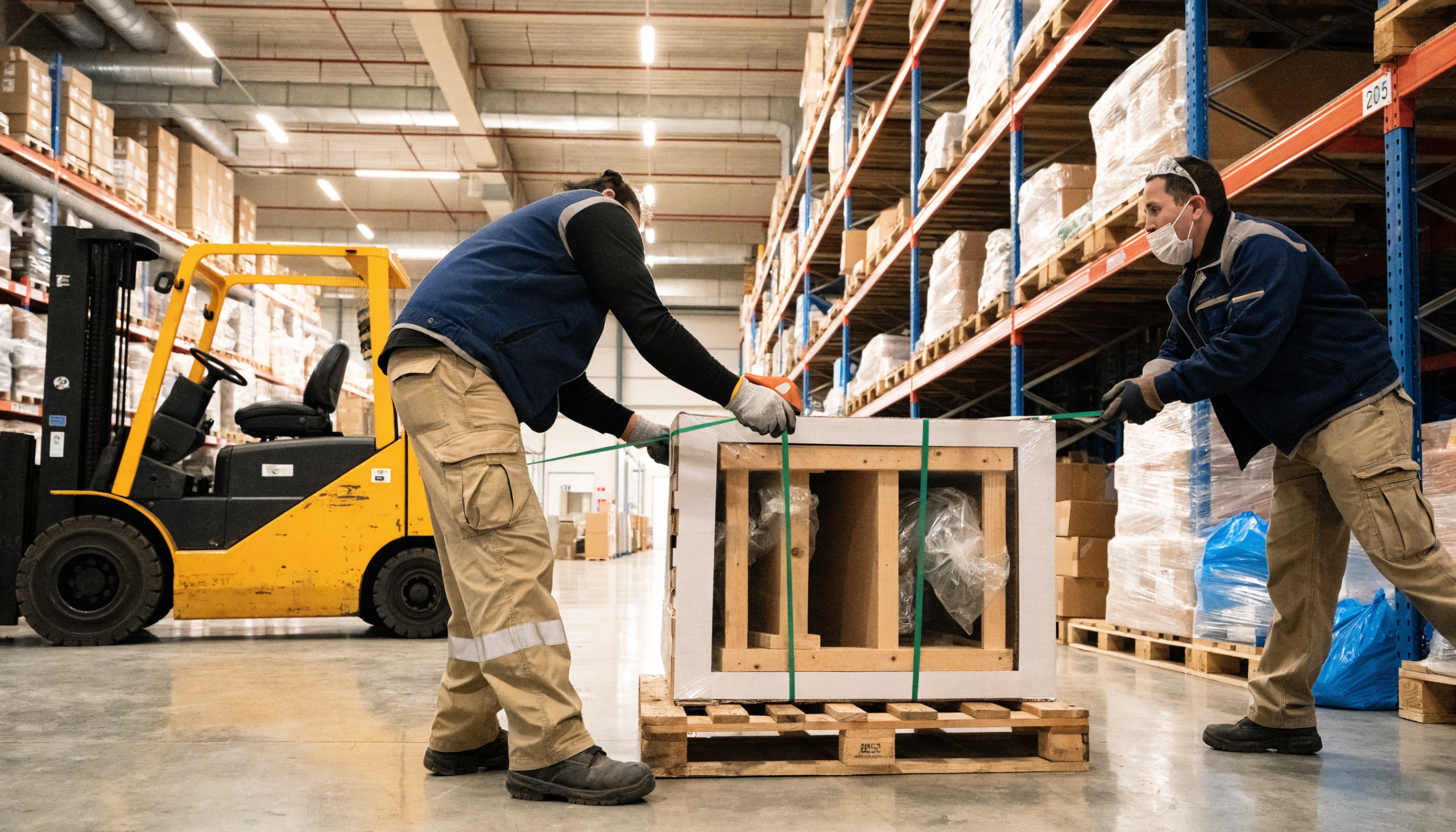
Furniture, exercise equipment, kayaks, area rugs, standing desks: big and bulky is one of the fastest-growing ecommerce categories — and the easiest place to destroy your margins. A single mislabeled sofa shipment can trigger hundreds of dollars in surcharges, and the difference between parcel and freight on the same item can exceed 50%.
Shipping oversized items in 2026 got even trickier: UPS and FedEx introduced cubic volume calculations for surcharges, USPS tightened its dimensional weight divisor to 139, and oversize penalties now routinely run $75 to $150 per package — before the base rate.
This guide walks through where the parcel network ends, where LTL freight begins, and how ecommerce sellers ship big items without giving the profit to the carrier.
What Counts as « Oversized » in 2026
Each carrier draws the lines differently, but the thresholds that matter most for online sellers are:
- Additional handling kicks in around 50 lb, or when the longest side exceeds 48 inches — adding roughly $25-$40 per package.
- Oversize / large package surcharges apply when length plus girth passes about 105-130 inches — often $75-$150 per package, and $300+ at the extreme tiers.
- Parcel network limits end near 150 lb or 108 inches in length: beyond that, your item physically can’t ride the parcel network and must move as freight.
The 2026 twist is cubic-volume-based surcharge triggers at UPS and FedEx: a light but voluminous box (think a disassembled chair) can now cost as much to ship as a heavy one. Measure every SKU — surcharges are assessed on the box, not the product.
Parcel vs LTL: The Real Cost Comparison
Here’s how the two modes typically stack up in 2026 for a big-and-bulky order. Figures are indicative and vary by lane, carrier and contract.
| Factor | Oversized Parcel | LTL Freight |
|---|---|---|
| Base cost (mid-distance lane) | $60-$150 + surcharges | $80-$250 per shipment |
| Oversize penalties | $75-$150+ per package | None (freight class pricing) |
| Residential delivery | Included, ~$5-$7 surcharge | $90-$150 accessorial + liftgate fees |
| Example: crated sofa, 500-1,000 miles | Usually not accepted | ~$280-$480 + $265-$410 accessorials |
| Best for | Under ~90 lb, one manageable box | 150 lb+, palletized, or multi-box orders |
The rule of thumb: above roughly 150 lb to a commercial address, LTL usually wins — industry data shows 50-70% savings on heavy, bulky items. To a residential address the math is murkier, because liftgate and home-delivery accessorials of $265-$410 can erase the freight advantage on smaller pieces. Always compare the all-in cost, not the base rate.
Keeping Big Items in the Parcel Network (When You Can)
If an item can legitimately stay under parcel thresholds, that’s usually the cheapest and fastest customer experience. Three tactics help:
- Ship in multiple boxes. A bed frame in two 45-lb boxes often costs less than one 90-lb box that triggers oversize penalties. Flat-pack design is a shipping strategy, not just an IKEA aesthetic.
- Right-size ruthlessly. With cubic-volume surcharge triggers, two inches of extra foam can push a package into a $100 penalty tier. Custom box sizes pay for themselves fast in this category.
- Audit your dimensional data. Carriers scan and re-measure every package; wrong dimensions in your system mean surprise adjustments on your invoice — and oversize adjustments are the most expensive kind.
When You Move to Freight: What Ecommerce Sellers Must Know
Palletize properly
LTL pricing assumes a stable, stackable pallet. Crate or corner-board furniture, strap it to the pallet, and wrap it — damage claims on poorly packed freight are routinely denied.
Budget the accessorials
Residential delivery, liftgate, limited access and delivery appointments each add fees. For home delivery of furniture, accessorials often cost more than the linehaul. White-glove service (inside delivery, assembly, debris removal) runs $150-$400+ but converts buyers on high-ticket items.
Set delivery expectations at checkout
Freight isn’t tracked like a parcel and usually books a delivery appointment window. Tell customers this upfront: surprise freight logistics are a top driver of negative reviews in the furniture category.
The Margin Playbook for Big and Bulky
- Price shipping into the product where possible — « free shipping » converts dramatically better on furniture, and the cost is predictable once your lanes are mapped.
- Position inventory near customers. Oversize costs scale hard with distance; a second warehouse can cut zone-related costs 25-40% on bulky SKUs.
- Use a multi-carrier mix. Regional carriers and dedicated big-and-bulky networks often beat national parcel carriers on oversize lanes.
- Insure high-value pieces. Freight liability coverage is based on weight class, not item value — a $2,000 sofa may only carry a few hundred dollars of default coverage.
The Bottom Line
Oversized shipping in 2026 punishes sellers who treat it like regular parcel shipping — and rewards the ones who measure, split, palletize and rate-shop deliberately. Know your thresholds, compare parcel vs LTL on every heavy SKU, and build the accessorials into your pricing before the carrier builds them into your invoice.
Shipping big items and tired of surcharge surprises? HereWeShip helps ecommerce sellers compare parcel and freight options and ship oversized orders at the lowest all-in cost. Get your rates today.
All rates and surcharges cited are indicative 2026 figures and vary by carrier agreement, lane and service level.