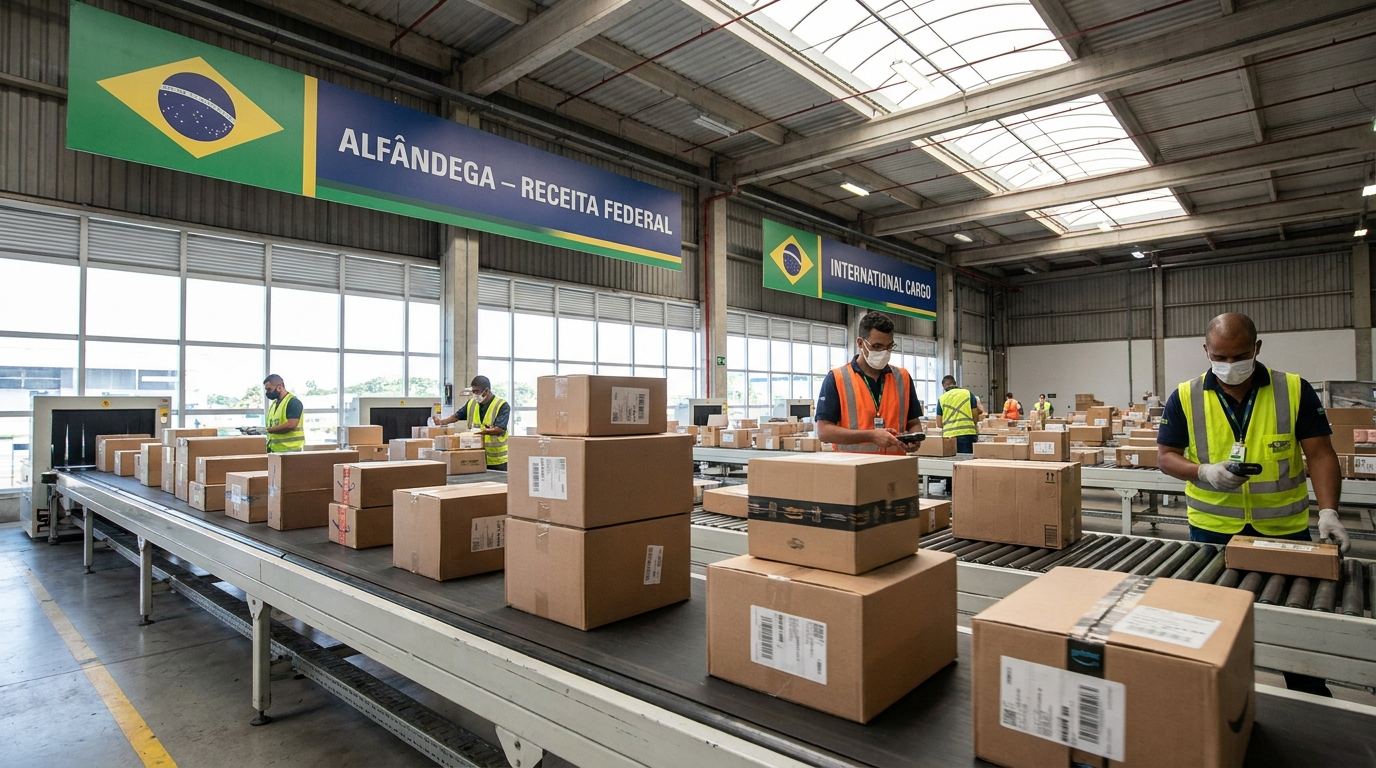
Brazil is the largest ecommerce market in Latin America and one of the fastest-growing cross-border destinations for US sellers. It is also, without much competition, the most heavily taxed. Shipping to Brazil in 2026 means every parcel is taxed — there is no meaningful de minimis threshold left to hide behind.
The good news is that Brazil’s rules are unusually explicit. Unlike markets where duty depends on nuanced HS classification, Brazil applies flat percentage tiers to low-value ecommerce parcels. Once you understand the two tiers and the state tax layered on top, you can quote a landed cost with real accuracy.
The bad news is what happens if you ignore them: parcels held at customs, buyers hit with unexpected bills at delivery, and refused deliveries that come back to you as return freight.
The 2026 Import Tax Structure
Brazil’s Programa Remessa Conforme (PRC), sometimes called the Compliant Remittance program, is the framework that governs low-value ecommerce imports. Here is how the tiers work.
| Shipment value (CIF) | Federal import duty | Notes |
|---|---|---|
| Up to US$50 | 20% | Reduced rate for PRC-registered sellers and platforms |
| US$50.01 to US$3,000 | 60% | Applied with a US$20 deduction on the duty amount |
| Above US$3,000 | Formal import | Falls outside the simplified express regime |
Two details matter enormously here. First, the value assessed is CIF — cost, insurance and freight. Your shipping charge is part of the taxable base, not excluded from it. Second, non-PRC shipments do not get the 20% tier at all; without registration, low-value parcels face the higher treatment.
All figures are indicative. Brazilian tax rules and program requirements have changed repeatedly and vary by state and shipment type. Confirm current rates with your carrier or customs broker before quoting.
ICMS: The State Tax Everyone Forgets
Federal import duty is only half the story. Brazil’s states levy ICMS, a value-added tax on goods circulation, on top of the federal charge. For international postal and express shipments, the rate is commonly around 17%, though several states have moved higher in recent years.
Stack the layers and the arithmetic gets uncomfortable fast. A US$45 order with US$15 shipping has a CIF value of US$60, which pushes it into the 60% tier. Add ICMS and the buyer’s total tax burden can approach or exceed the value of the goods themselves.
This is why the US$50 CIF line is the single most important number in your Brazil strategy. Crossing it by a few dollars — often because of the shipping charge, not the product — triples the duty rate.
Why Remessa Conforme Registration Matters
PRC certification is what unlocks the 20% tier and materially faster clearance. Major platforms including AliExpress, Shein and Amazon registered early, which is a large part of why they can quote all-in prices at checkout while smaller sellers cannot.
Registered participants must collect import duty and ICMS from the buyer before the parcel ships, transmit shipment data to Brazilian customs in advance, and disclose the total cost including federal and state taxes at checkout.
For most independent US sellers, direct registration is impractical. The realistic paths are:
- Ship through a PRC-registered partner — a cross-border carrier, marketplace or DDP provider that holds certification and clears under its own program status.
- Sell through a registered marketplace and let the platform handle tax collection and remittance.
- Ship DDU and accept the consequences — slower clearance, buyer-paid taxes at delivery, and higher refusal rates.
Carrier Options and Transit Times
Your carrier choice affects clearance speed as much as transit speed.
- Express integrators (DHL, FedEx, UPS). Roughly 4 to 8 business days door to door, with their own brokerage. Highest cost, most predictable clearance, best tracking.
- USPS to Correios. Cheapest option for lightweight parcels, but transit commonly runs 2 to 6 weeks and clearance visibility is limited once the parcel hands off.
- Cross-border consolidators. Often the sweet spot for ecommerce volume — PRC-registered, DDP-capable, with pricing between postal and express.
Whatever you choose, Brazilian customs requires the recipient’s CPF (individual taxpayer number) or CNPJ (business number) on the shipment. A parcel without a valid CPF will not clear. Collect it at checkout, validate the format, and pass it in the customs data — this single field causes more Brazil clearance failures than any other.
Six Rules for Selling into Brazil Profitably
1. Show landed cost at checkout
Brazilian buyers are experienced importers and expect tax-inclusive pricing. A surprise bill at delivery in this market means refusal, not just a complaint.
2. Engineer around the US$50 CIF line
Because freight counts toward CIF, a cheap product with expensive shipping can cross into the 60% tier. Model the total, not the item price.
3. Collect and validate CPF at checkout
Make it a required field for Brazilian addresses, with format validation. This is non-negotiable.
4. Ship DDP wherever possible
Prepaid duties convert a hostile delivery experience into a normal one and sharply reduce refusals and returns.
5. Classify accurately
Brazilian customs applies scrutiny to undervaluation. Declaring below actual transaction value risks seizure and penalties that dwarf the tax saved.
6. Set expectations on transit time
Publish realistic delivery windows that include clearance. An honest 21-day estimate outperforms an optimistic 10-day estimate that fails.
The Bottom Line
Brazil rewards preparation and punishes improvisation. The tax structure is steep but knowable: 20% under US$50 CIF, 60% above it, plus roughly 17% ICMS, with PRC registration as the gateway to the lower tier and faster clearance.
Sellers who quote landed cost honestly, collect CPF properly and ship through a registered partner can build a durable Brazilian channel. Sellers who treat it like any other international destination will spend their margin on returns and refused parcels.
Ready to open Brazil without the guesswork? Compare cross-border carrier options and get accurate landed-cost quoting for every destination at HereWeShip.