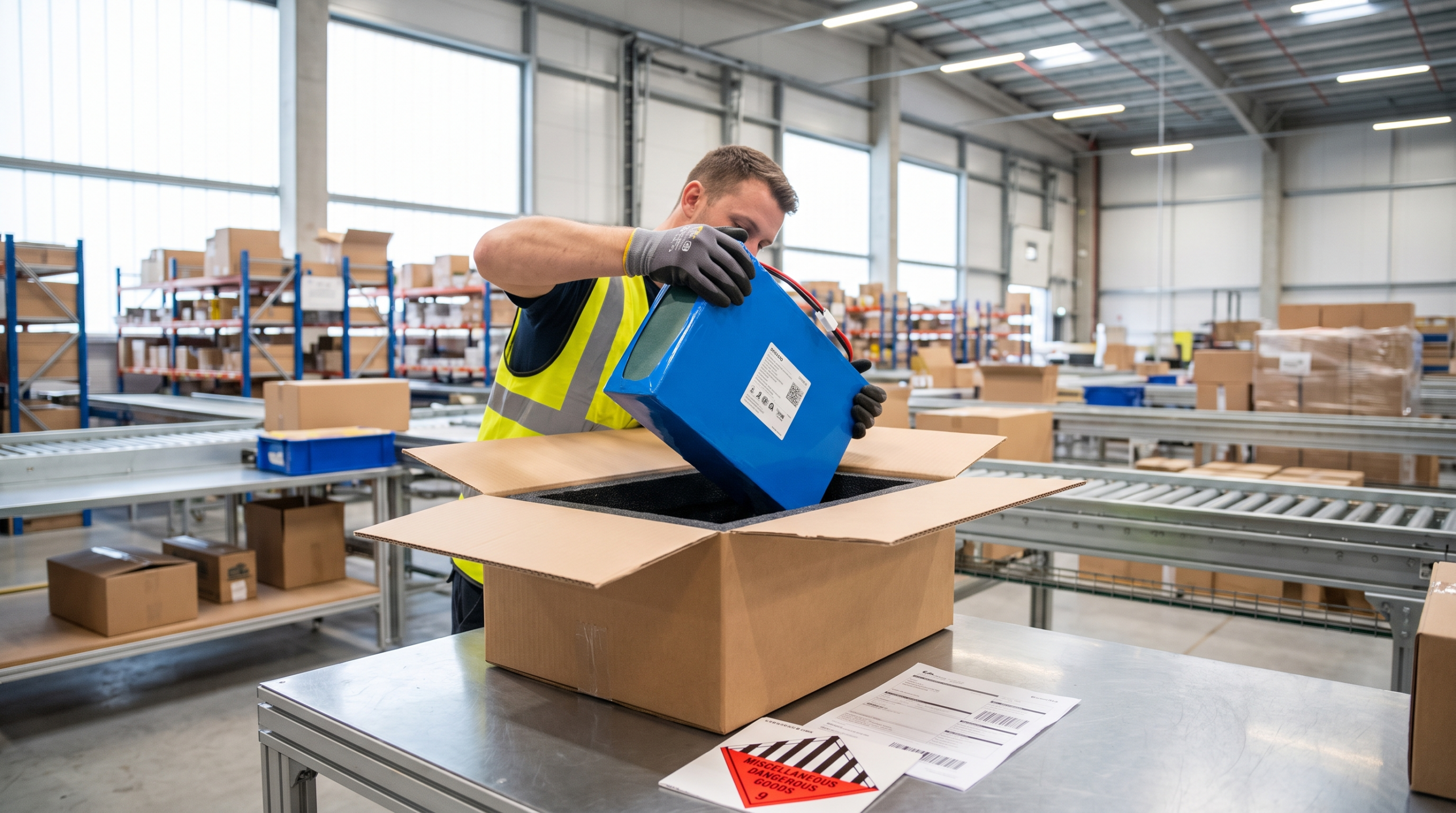
If your store sells earbuds, power banks, drones, cordless tools, electric toothbrushes or anything with a rechargeable cell inside, you are a hazmat shipper. Most sellers find that out the first time a $50 fee lands on their USPS invoice.
Since 12 July 2026, USPS has charged a $50 noncompliance fee per package for undeclared hazardous materials in commercial shipments. FedEx has reportedly charged around $350 per package for undeclared hazmat for years. The rules themselves have not become harder, but detection has, and a new battery mark becomes mandatory on 1 January 2027.
Here is what shipping lithium batteries actually requires in 2026, and the handful of operational changes that keep the fees off your invoice.
What counts as hazmat in an ecommerce catalogue
Sellers routinely underestimate how much of a typical catalogue is regulated. Four categories cover most of it.
| Category | Typical products | Common UN number |
|---|---|---|
| Lithium batteries | Phones, laptops, power banks, earbuds, drones, e-bikes | UN3480, UN3481 |
| Pressurized containers | Hairspray, deodorant, spray paint, dry shampoo | UN1950 |
| Flammable or reactive liquids | Perfume, nail polish and remover, hand sanitizer, lighter fluid | Varies by formulation |
| Strong magnets | Rare-earth magnets, magnetic mounts, some speakers and toys | Varies by field strength |
Always confirm the classification against each product’s Safety Data Sheet rather than assuming. A perfume at 20 percent alcohol and one at 80 percent are not the same shipment.
The UN numbers that matter
- UN3480 — standalone lithium-ion batteries, shipped on their own.
- UN3481 — lithium-ion batteries packed with, or contained in, equipment. This is what most ecommerce orders actually are.
- UN3090 — standalone lithium metal batteries.
- UN3091 — lithium metal batteries packed with or contained in equipment.
Smaller cells get lighter treatment. Lithium-ion is generally considered small at or below 20 Wh per cell and 100 Wh per battery; lithium metal at or below 1 gram of lithium per cell and 2 grams per battery. Qualifying for an exception does not remove packaging, marking or transport-mode requirements. It only changes which set applies.
The USPS fees, and how they stack
| Fee | Amount | When it applies |
|---|---|---|
| Hazmat noncompliance fee | $50 per package | Undeclared hazmat found in a commercial shipment |
| Hazmat handling fee — Priority Mail Express, Priority Mail | $7.50 | Properly declared hazmat |
| Hazmat handling fee — Ground Advantage, Parcel Select | $0 initially | Properly declared hazmat; a future increase is flagged |
| FedEx undeclared hazmat | Around $350 per package | Undeclared hazmat detected in network |
The noncompliance fees do not add together: you pay the higher of the hazmat fee or the package quality fee. The handling fee can be charged on top of either.
USPS applies a Hazmat Quality category with zero tolerance. Failing any one of eight checks triggers the fee, and those checks cover hazmat symbols, Service Type Codes, barcode banner text and DOT markings. Detection comes from electronic manifest screening, physical inspection triggers and X-ray.
The practical consequence: declaring hazmat correctly on a Ground Advantage parcel currently costs nothing extra, while getting it wrong costs $50. There is no financial argument for guessing.
The label change on 1 January 2027
The older lithium battery mark, the one that included a telephone number, can be used until 31 December 2026. From 1 January 2027, shippers must use the version carrying only the battery symbol and the UN number. The phone number was removed because it created confusion over whether anyone had to monitor it.
If you print marks in-house, change the artwork now rather than in December. If you buy preprinted labels, stop reordering the old version and run down existing stock before year end. Sellers who leave this to the last week of December will be the ones holding non-compliant inventory in peak season.
Packaging that passes
Poly mailers and padded envelopes are not compliant for hazmat, no matter how small the item. Rigid outer packaging is required, and the board grade matters:
- Packages up to 20 lb: minimum ECT 32, or 200 lb burst strength.
- Packages above 20 lb: minimum ECT 44, or 275 lb burst strength.
On the outside of the box you need the DOT hazard labels, the proper shipping name, the UN number and the lithium battery mark. Inside, terminals must be protected against short circuit and the battery immobilized so it cannot move in transit.
Damaged, defective and recalled batteries
Under 49 CFR 173.185, damaged or recalled batteries may move only by highway, rail or vessel, and the outer package must state that it contains a damaged or defective battery. For USPS domestic mailing, standalone lithium batteries are generally restricted to surface transportation, and used, damaged or defective devices containing lithium batteries are barred from air transport, with exceptions for new or manufacturer-certified devices. Those devices must be marked Restricted Electronic Device and Surface Transportation Only.
This matters most for returns and warranty programs. A customer sending back a swollen battery is a hazmat shipment moving in the wrong direction, and the return label you emailed them almost certainly does not cover it.
FBA versus FBM: who carries the risk
Sellers fulfilling their own orders on Amazon, eBay, Etsy and Shopify carry the compliance responsibility themselves. FBA sellers are largely insulated once inventory is accepted into the network, though getting it there is still a hazmat shipment governed by Amazon’s own dangerous goods program.
If you use a prep centre, verify it is hazmat certified before sending inventory. Hazmat prep typically costs more than standard prep, and a prep centre that quietly skips the marking step hands you the fee, not them.
Shipments to APO, FPO, DPO and US territories follow international dangerous goods rules rather than domestic ones, which is stricter than most sellers expect.
Seller checklist
- Run every SKU through the USPS Hazmat Search Tool or its Safety Data Sheet, and record the result against the SKU.
- Declare hazmat when the label is created so the correct Service Type Code is populated. Doing it after the fact does not help.
- Apply the DOT hazard label, proper shipping name, UN number and lithium battery mark to the outer box.
- Switch to the new battery mark before 1 January 2027.
- Use rigid cartons at ECT 32 or ECT 44 depending on weight. Retire poly mailers for these SKUs.
- Separate hazmat at drop-off and present it in a container marked HAZMAT.
- Write a returns policy that routes battery returns through a compliant process rather than a standard prepaid label.
Treat it as a line item, not a legal problem
Hazmat compliance looks intimidating because it is written in regulatory language, but operationally it comes down to classification data on each SKU, the right marks on the box and the right board grade underneath them. Build it into your product data once and the $50 fees stop appearing.
At HereWeShip we help online sellers classify their catalogue, set up compliant packaging and route restricted products through the services that accept them. Talk to our team before your next battery-powered SKU goes live.
Fees, thresholds and effective dates above are indicative at the time of publication and change by carrier and service. Verify current requirements against 49 CFR 173.185, the IATA Dangerous Goods Regulations and your carrier’s own hazmat publications before shipping.